

At 10:28 p.m. on December 3, 2024, South Korean President Yoon Suk Yeol declared emergency martial law. Shortly after 1 a.m. the next day, all 190 lawmakers present in the National Assembly voted to pass a resolution demanding its termination. The entire episode lasted approximately six hours. The Seoul Guardians (2026), co-directed by MBC journalists KIM Jong-woo, KIM Shin-wan, and CHO Chul-young, compresses those six hours into just over seventy minutes, reconstructing the chaos and confrontation inside and outside the National Assembly. The Seoul Guardians not only records the course of a political crisis, but also bears witness to the anxiety shared by everyone present during those hours——no one knew what the military would do next.
The film quotes a question posed by writer Han Kang in “Light and Thread,” her Nobel Prize in Literature lecture delivered on December 7, 2024. She recalled repeatedly asking herself while researching the Gwangju Uprising for Human Acts: “Can the present help the past? Can the living save the dead?” She later reversed those questions: “Can the past help the present? Can the dead save the living?” This pair of questions provides an essential key to understanding The Seoul Guardians. What the film ultimately seeks to demonstrate is how the memory of the 1980 Gwangju Uprising shaped that night in 2024. The anxiety felt so tangible precisely because people remembered Gwangju.
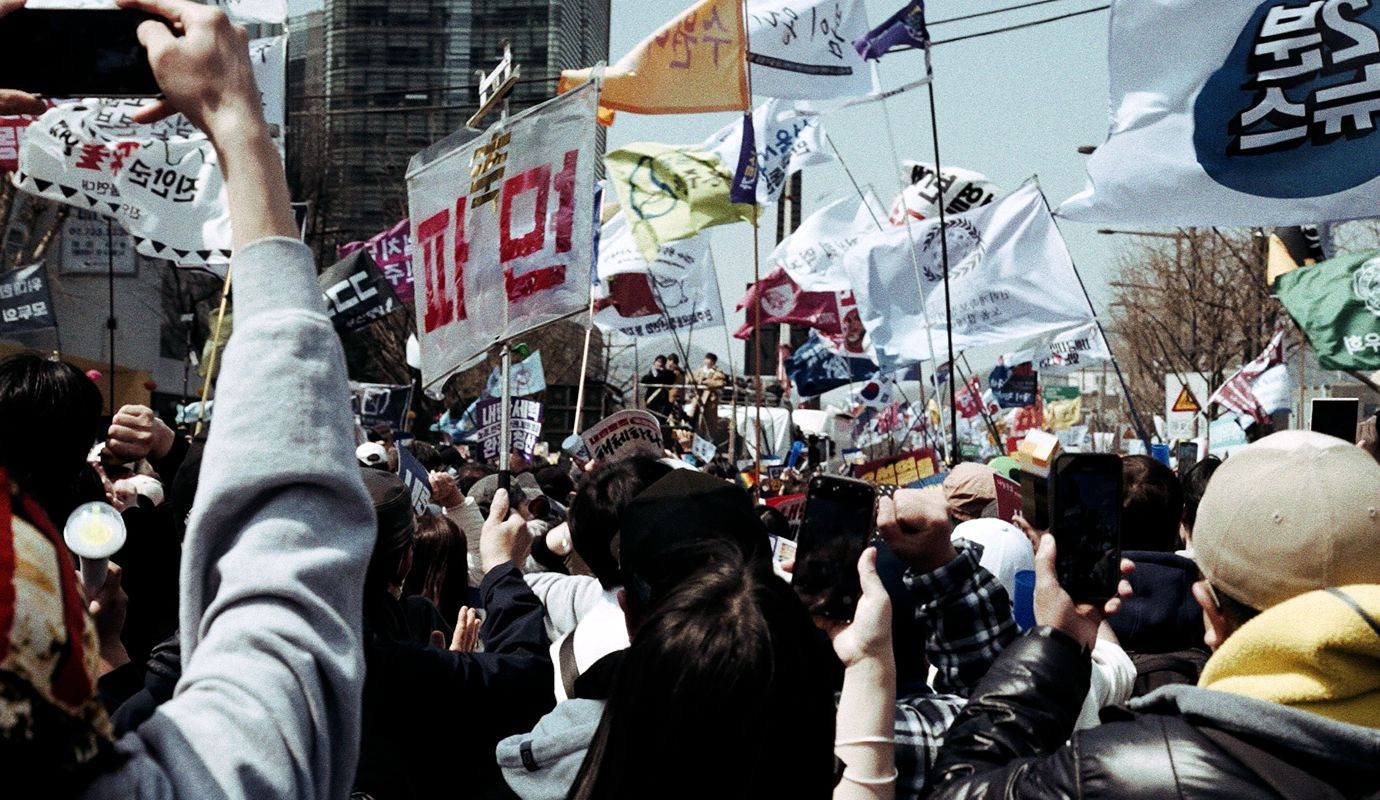
The film is composed almost entirely of handheld footage shot by numerous journalists who were at the National Assembly that night. The abundance of camera positions allows it to move between the building’s main entrance, lobby, and assembly chamber, placing citizens, lawmakers, soldiers, journalists, the Speaker, and the Secretary-General within the same spatial framework. Viewers gradually come to understand the physical layout of the entire legislature during those hours: who was kept outside, who climbed over the walls, and where the troops advanced from. In this sense, the camera functions as a witness. The directors allow the images from the scene to propel events forward on their own, leading many international critics to place the film within a nearly observational documentary tradition.
Yet it would not be entirely accurate to say the film lacks an authorial voice. The directors’ intervention is concentrated in the editing, most visibly through the insertion of archival footage from the Gwangju Democratization Movement. One of the most powerful sequences uses a match cut to connect images of military helicopters arriving at the National Assembly during the 2024 martial law declaration with archival footage of airborne troops under Chun Doo-hwan.
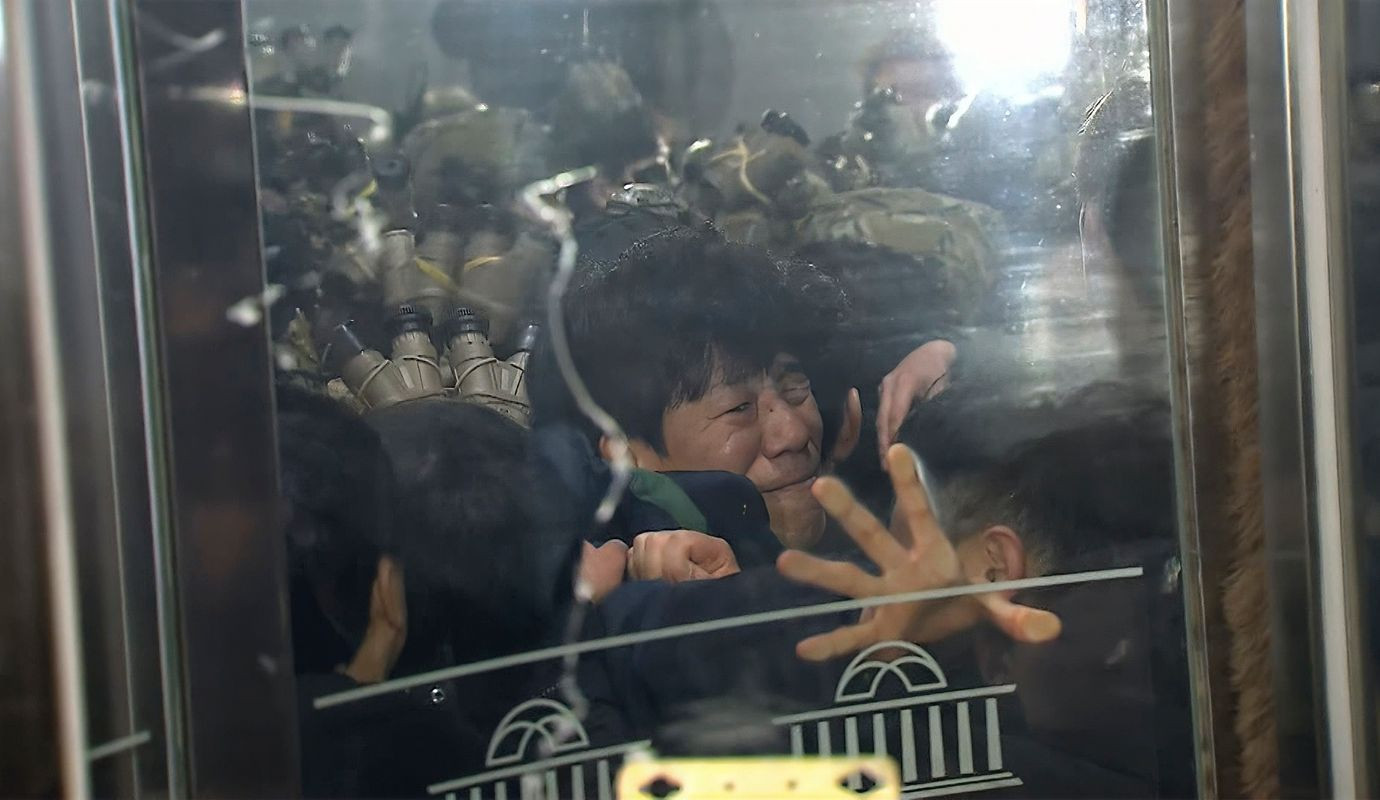
The two moments in time overlap through the same visual motif. Without any need for narration to declare it, viewers can read the film’s argument: history might repeat itself that night. From this perspective, Han Kang’s questions are more than an epigraph; they are put into practice throughout the film through the intercutting of past and present, as images of the past enter the frame of the present. The narration, by comparison, is restrained. When it occasionally appears, it mostly names this juxtaposition, and at times repeats what the editing has already said.
One passage, however, is markedly different. The director holding the camera leaves the crowd and walks alone up a flight of stairs as the narration expresses something close to a sense of grievance. It is one of the film’s few moments that turns away from the event itself and toward the person recording it. As troops close in on the National Assembly, the recorder is also a potential victim. Perhaps the anxiety has grown so overwhelming that it obscures even the conviction to defend freedom and democracy. This feeling is difficult to reveal, yet real; the citizens of Gwangju may once have felt the same. For a moment, the narration breaks the division of labor in which “the camera bears witness and the editing makes the argument.” It also adds another meaning to the “guardians” of the title: those defending democracy are themselves living within anxiety. That anxiety forms the emotional ground of the entire film.
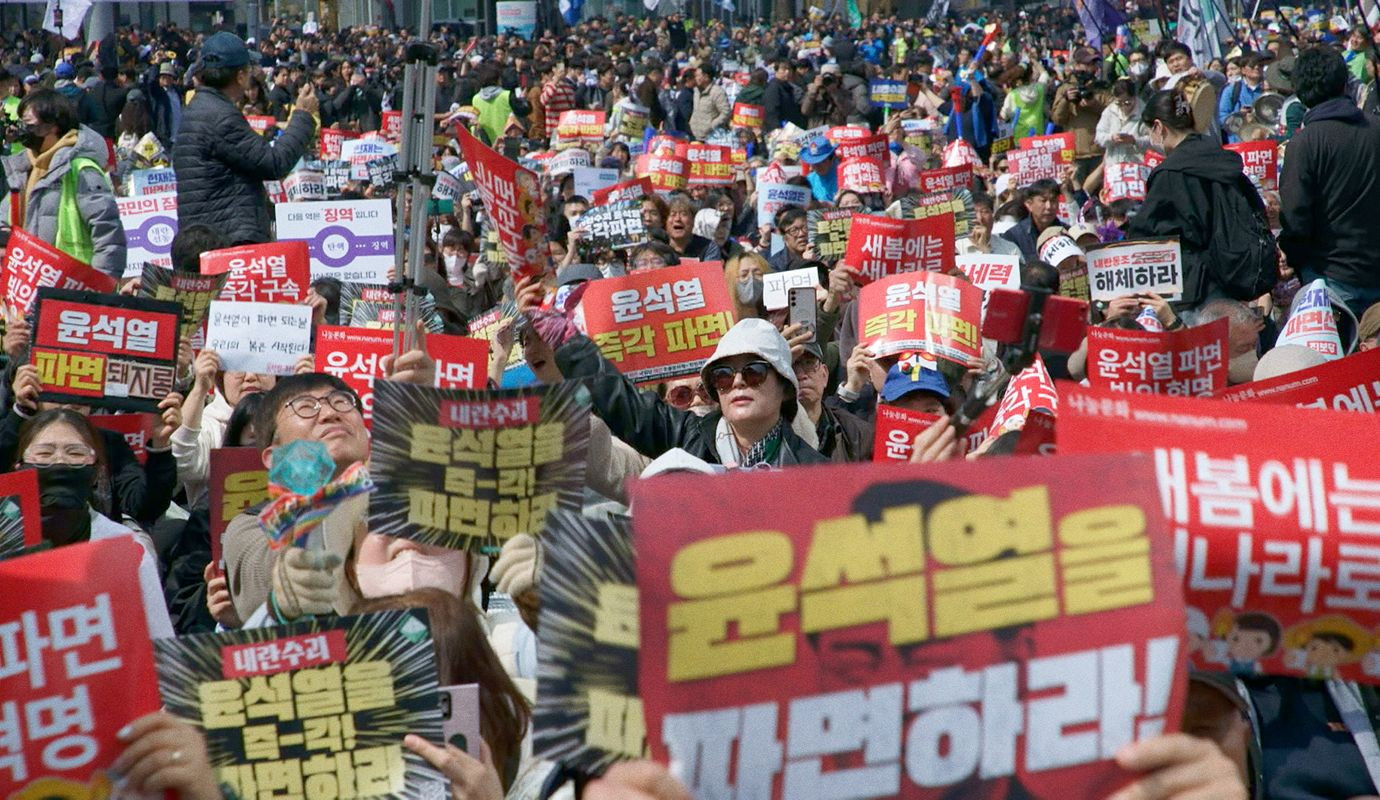
The central conviction of The Seoul Guardians is that the past saved the present. Because the memory of Gwangju endured, that night in 2024 did not become another massacre: the soldiers did not fire, and the pushing between troops and civilians did not escalate into bloodshed. This belief is moving, but it is worth noting that it is constructed to a significant extent through editing. The camera can capture a soldier’s hesitation, but not the reason for it. Other conditions that may also have shaped the outcome——the National Assembly quickly assembling enough lawmakers for a vote, and the event being broadcast live on television and online——are more difficult to place alongside the images of Gwangju.
For this reason, The Seoul Guardians is both an on-the-ground record of six hours and a statement about collective memory. It responds directly to Han Kang’s reversed question——can the dead save the living? The film gives an affirmative answer, and that answer has itself become one way in which this history is told. Yet before the outcome was known, the guardians possessed no answer, only anxiety; the only thing they could rely on was memory.
Written by Cammy Hou
Film stills: Reproduced from the Taipei Golden Horse Film Festival website